
What Julia Wrote: January 9 to 15
/On January 1, I started going back into the diaries of Julia Wilbur, extracting an excerpt a day to post on Facebook (ptwhitacre) and Instagram (ptwhit). I compile the week’s postings here, starting last week.
It has definitely been a learning curve, including (1) I should not publish the same photo every day, (2) it is hard to find relevant, royalty-free images, and (3) things happen deep in social media accounts that are really unfindable even with step-by-step directions about where to find them.
As a reminder, Julia Wilbur (1815-1895) was an abolitionist and suffragist who kept a diary for 50 years. Original diary in Quaker & Special Collections, Haverford College, available through TriCollege Libraries Digital Collections. I drew on these diaries to write a biography of Wilbur, A Civil Life in an Uncivil Time, published by Potomac Books/University of Nebraska Press in 2017.
Let’s forge on to give a platform to our nineteenth-century friend.
(Note that the dates are sequential, but the years hop across the 1860s.)
January 9, 1863
In early January, 1863, Wilbur was part of a small group of civilians visiting Falmouth, after the U.S. Army rout at Fredericksburg.
What Julia Wrote on that day:
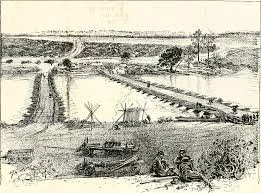
“On one end stand [of a bridge…our pickets & on the other end the rebel pickets. We were within speaking distance of the rebels. We saw several wearing the blue overcoats of our soldiers….The Camp fires light the whole horizon. Union and rebel fires make up the panorama. It is a grand sight. Bands were playing most of the evening….Could hardly realize that I was in the midst of the ‘Grand Army of the Potomac.’”
A striking scene near the front lines of battle, after, I might add, a humiliatating Federal defeat.
January 10, 1863
The next day, Jan. 10, 1863, she stopped in Aquia Creek, Virginia, on the way back to Alexandria.
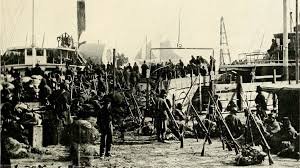
“Left Falmouth at 8.…We were in mail car & had good seat. Several sick soldiers brought in & the corpse of one just brought from Fredericksburg. At Aquia Ck. got pass to W [ashington]….Such a bustle & so much going on at Aquia. I suppose all the supplies for Burnside’s army are brought to this place on boats & then transferred to cars. Boats were loaded with men, cattle & stores of all kind. It was interesting. They are enlarging the wharves & the warehouses. Came up on the mail boat Wilson Small.”
Aquia Creek was a vital Federal Army logistics point during the war. It is now a quiet corner of Prince William County.
January 11, 1864
Meanwhile, back in Alexandria the next year:
“Small pox boy removed from this Hos[pital] yesterday. —People ordered to come here to be vaccinated, but Dr. Bigelow has been away all day, & people have waited here all day for him. Want of management somewhere.”
Smallpox was a continual scourge, especially in close living conditions. As she notes, vaccinations existed but they don’t work if they can’t be administered.
By the way, when I looked for photos to illustrate anything related to smallpox, I decided….well, maybe not.
January 12, 1866
The war over, on January 12, 1866, Wilbur joined other women to advocate for continued operation of an orphan asylum in Washington, DC, on property confiscated from a Confederate, Richard S. Cox.
What Julia Wrote on that day:
“At 1 P.M. met a Delegation of Ladies in East Room of White House. signed a petition to President against the unconditional pardon of R. Cox former owner of premises now occupied by Cold. Home for Orphans. The conditions are these: he must give up the building & 10 acres of land to the N. Assn. for Relief of Destitute Women & Children. If the property is confiscated, the Assn. want the privilege of buying it. I think there were 50 ladies….The President looked a little surprised & said he did not know that there would be over half a doz.”
They did not succeed in keeping the site for long but moved nearby. While the institutin eventually fell into neglect, it served a vital role helping formerly enslaved women and children for many decades.
January 13, 1861
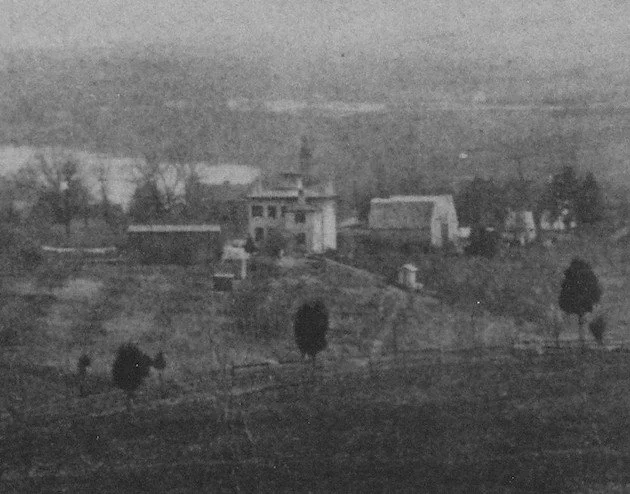
On January 13, 1861, Julia Wilbur was on her family’s farm in Rush, New York (outside of Rochester), little knowing what was to come.
What Julia Wrote on that day:
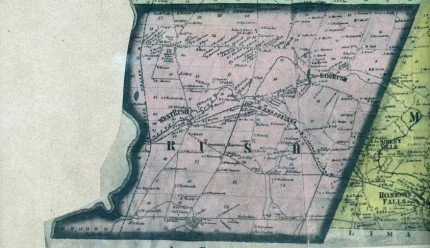
The Wilbur farm is noted in this map
“We have not been to the P. Office in 3 or 4 days. & have had no news for a week, & New York may be out of the Union for aught I know. Nobody been here during the week. The country may all go to ruin & we know nothing about it in this out-of-the-way place. To morrow we must try to get the news anyhow.”
Hard to fathom that kind of news black-out (though may be welcome some days!), but the country—and Wilbur herself—would soon see huge changes.
January 14, 1863
Harriet Jacobs, author of Incidents in the Life of a Slave Girl, came to Alexandria and met fellow relief agent Julia Wilbur on January 14, 1863.
What Julia Wrote on that day:
“Went to room [clothing distribution room] & worked awhile….Mary Mears called. Also Mrs. H. Jacobs. She is sent by N. Y. Friends to be matron of the contrabands [freedpeople] here, & they wish her to distribute the goods they send….Things do not look as promising as they have done. I am annoyed & perplexed.”
From Julia’s point of view, their first meeting did not go well, as her diary reveals, although they soon became friends and allies for the rest of their lives. My own two cents is that Wilbur felt threatened by her newly arrived colleague.
January 15, 1866
On Jan. 15, 1866, Julia Wilbur was working for the Freedmen’s Bureau during one of Washington’s coldest winters on record.
What Julia Wrote on that day:
“Very cold. Visited 19 families. Snowed all P.M. Stormy evening. I have been so cold today. Dirty rooms. Smoky, Dark, cold. No fire in some. In others, a very little. Very tired tonight.”
She was discouraged to say the least. Her job as a relief agent was to visit families to assess need. Demand greatly outstripped supply.
To sum things up
Across various years from January 9 through 15, Julia Wilbur visited the front lines of battle, attended a meeting with President Andrew Johnson, and met the person who would become one of the most controversial people in her life, Harriet Jacobs.
To follow along
I’ll post day-by-days on Facebook (@ptwhitacre) and Instagram (@ptwhit). I’ll compile the week’s entries here and on Substack (Discovering Lives).