What Julia Wrote: February 6 to February 12
/As the Civil War began, Julia Wilbur could only get involved vicariously through several male relatives who enlisted. She got into the action herself in late 1862, when she moved to Alexandria, Virginia, as a relief worker.
Since January 1, I have admittedly been doing some cherry-picking from her diaries for a look at what she saw, did, and felt. This week, in the first entry below, I broke protocol by going back to the previous day. When you read it, I hope you agree it was worth it.
As a reminder, Julia Wilbur (1815-1895) was an abolitionist and suffragist who kept a diary for 50 years. Original diaries are in Quaker & Special Collections, Haverford College, available through TriCollege Libraries Digital Collections. I drew on these diaries to write a biography of Wilbur, A Civil Life in an Uncivil Time, published by Potomac Books/University of Nebraska Press in 2017 and in my upcoming book, Alexandria on Edge: Civil War, Reconstruction, and Remembrance on the Banks of the Potomac. Read more about that elsewhere on my website.
Okay, let’s forge on to give a platform to our nineteenth-century friend.
(Note that the dates are sequential, but the years hop across the early- to mid-1860s.
February 6, 1864
I’m going back a day in my day-by-day of the Civil War through the eyes of Julia Wilbur, because I missed something big on Feb. 5, 1865 (writing this right now on Feb. 6)
What Julia Wrote on that day:
“About 3 1/2 P.M. Louisa [Jacobs] & Virginia [Collier] went with me to the Cemetery. First to the Potters Field to see where Contrabands [freedpeople] are packed away. Talked with a grave digger, says he has been told to put 3 or 4 into one grave. I intend to complain of the state of things here. It is disgraceful to have such a state of things exist….Then we went to the Soldiers Burying Ground. A large number of workmen are employed here all the while to improve it & make it beautiful. What a contrast to the burying place of the Contrabands.”
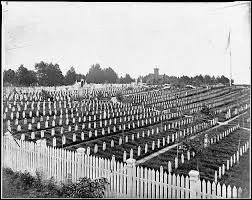
The new burial Ground was similar in design to Soldiers Cemetery, depicted here.
Within months of this entry, the “Potters Field” was considered so overfilled that a new burial ground was established—now the Contrabands and Freedmen Cemetery Memorial. The Soldiers Cemetery is now Alexandria National Cemetery. With death so pervasive, Julia had occasion to visit (and write about) both of these places often.
February 7, 1865
In Washington, Julia Wilbur set up a room to distribute clothing to freedpeople, as she had in Alexandria. On February 7, 1865, she also read about an old acquaintance.
What Julia Wrote on that day:
“Snow, hail, rain, Oh! The sunny South!…. Spent nearly all day in Clothing room sorting over & arranging my clothing. Have things nearly all straitened up now. Box came from Ch. Soc. Phila. yesterday.—Letter from J. Cornell who has sent box valued at $200. Too bad to go among the people today & how they must suffer, in this wet storm. Our room is comfortable this evening. I wish everybody had so good a place…..Have read in the Phila. Inq. that Col. DeKorponay is to have command of a Regt. in Gen. Hancock’s new Corps. I wonder if he is the same drunken scamp that he was a year & a half ago?”
In 1863, Col. Gabriel De Korponoy invited Julia and other guests to a Thanksgiving feast at Fort Ellsworth. He had managed to get his hands on quite a bit of wine for the occasion. He also claimed to have introduced the polka to U.S. society.
February 8, 1866
In early February 1866, Julia Wilbur was working for the Freedmen’s Bureau in Washington, and she sounds…..tired.
What Julia Wrote on February 7, 8, and 9:
Feb. 7: “Visited 20 families. Out nearly all day. Tired to night, dull & stupid. Have seen some queer people.”
Feb. 8: “Waited on people & gave tickets nearly all day. Tiresome work.”
Feb. 9: “Waited on people till 11 o’clock. Then visited 16 families. Walked through mud & mire. Worked at weekly Report.”
In this case, “waiting on” meant working in a clothing distribution room. “Visiting” was an intrusive practice set up by the Bureau to determine if people were truly needy by going house-to-house. And, as noted, filling out paperwork about them
February 9, 1862
At the beginning of the Civil War, Julia Wilbur relied on (male) family members to understand what was happening. On February 9, 1862, while home in Rush, New York, she heard from her brother-in-law Joseph Von Buskirk, who had enlisted in Michigan.
What Julia Wrote on that day:
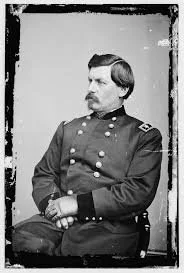
“Joe Van B. thinks that McClellan is all right, & that people are finding fault with him unnecessarily. Says the roads are so bad that the army can’t move at all. He had just been to Washington & has some photographs agoing & is to send me one.—No particular war news, only people are manifesting impatience & dissatisfaction at the way things are going.—McClellan is growing unpopular, & our troubles accumulate.”
About a month later, Gen. McClellan started his unsuccessful Peninsula Campaign. Troubles indeed accumulated for him.
February 10, 1863
On February 10, 1863, Julia Wilbur visited the sprawling Convalescent Camp that was set up near Alexandria.
What Julia Wrote on that day:
“In P.M. went to Convalescent Camp with Dr. & Mrs. Shaw. Mrs. K. & Mrs. Marshall. Worst road I ever saw. Not half so many tents as formerly, have gone into the barracks, 7,103 enlisted men there.”
This was actually the second, “new-and-improved” such camp. The first was closed after a few months of flooding, insufficient food, and all-around misery.
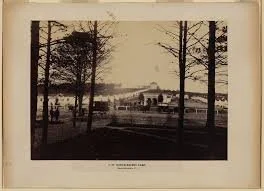
Camp Convalescent
February 11, 1865
On February 11, 1865, Julia Wilbur spent the day back in Alexandria, visiting from Washington.
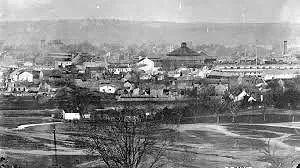
Alexandria, circa 1865
What Julia Wrote on that day:
“Bright. Warmer. Went to Alex. on 10 A.M. train. Called at Cor. W. & W. sts. [where she lived with Harriet Jacobs from late 1863-1865]…..About 150 people get rations now & wood also & rents are to be stopped in the old buildings until they are repainted & made comfortable….The troops that have been in the S. West seem all to be coming this way. The streets & cars in W. & Alex. are alive with soldiers. I have seen a vast number of shoulder straps today—This war is truly a big thing. I am told that the white hospitals are to be broken up in Alex. & only the colored (L’Ouverture) will remain.”
Not all, but several White-only hospitals did close in Alexandria as the war showed signs of ending.
February 12, 1864
Influential visitors came to Alexandria during the Civil War. On February 12, 1864, Julia Wilbur commented on the presence of three.
What Julia Wrote on that day:
“Went to Commissary, drew rations under the new order. They receive 3000 for 10 days making 300 a day.—I supposed, including children, there are 400 who draw rations here…Downing, Remond & Smith here.”
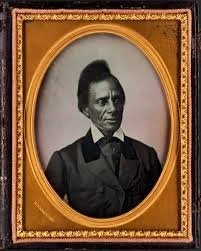
Charles Lenox Remond
She was referring to Black abolitionists George T. Downing, Charles Remond, and Joshua Bowen Smith—but please correct me if not. The three men, she reported, gave speeches, visited around, and tried to recruit Black soldiers, and were in Alexandria on and off from January through at least March of that year.
Looking back
During the week of February 6 through February 12, across various years, Julia Wilbur witnessed burials, distributed aid, and met some of the leading Black abolitionists of the day.
To follow along
I post day-by-days on Facebook (@ptwhitacre) and Instagram (@ptwhit). Please visit and comment there, or come back here for the overview. I’ll also compile next week’s entries here and on Substack.