
What Julia Wrote: January 30 to February 6
/As we head into Black History Month, I continue to look back at the diaries of Julia Wilbur. In 1861 and 1862, Wilbur, a white schoolteacher from Rochester, NY, was itching to become involved in the great push for freedom during the Civil War.
Her chance came when the Rochester Ladies’ Anti-Slavery Society, of which she was a member, decided to sponsor a relief agent to help people escaping slavery. Wilbur was the perfect candidate—as much for her skills and convictions as the fact that she was middle-aged and single!
She lived and worked in Alexandria, Virginia, from 1862 through early 1865 when thousands of people came into the city to escape slavery. In early February 1865, she moved into Washington and worked with the Freedmen’s Bureau. As you’ll see in some of these and other diary entries, she was both compassionate and patronizing, helpful and judgmental, brave and sanctimonious.
As a reminder, Julia Wilbur’s original diaries are in the Quaker & Special Collections, Haverford College, available through TriCollege Libraries Digital Collections. I drew on these diaries to write a biography of Wilbur, A Civil Life in an Uncivil Time, published by Potomac Books/University of Nebraska Press in 2017 and in my upcoming book, Alexandria on Edge: Civil War, Reconstruction, and Remembrance on the Banks of the Potomac.
Okay, let’s forge on to give a platform to our nineteenth-century friend.
(Note that the dates are sequential, but the years hop across the early- to mid-1860s.)
January 30, 1864
Julia Wilbur loved her niece Mary Julia (known as Sis), but was also exasperated by her. On January 30, 1864, she took Sis on what she wanted to be an educational trip around Washington.
What Julia Wrote on that day:
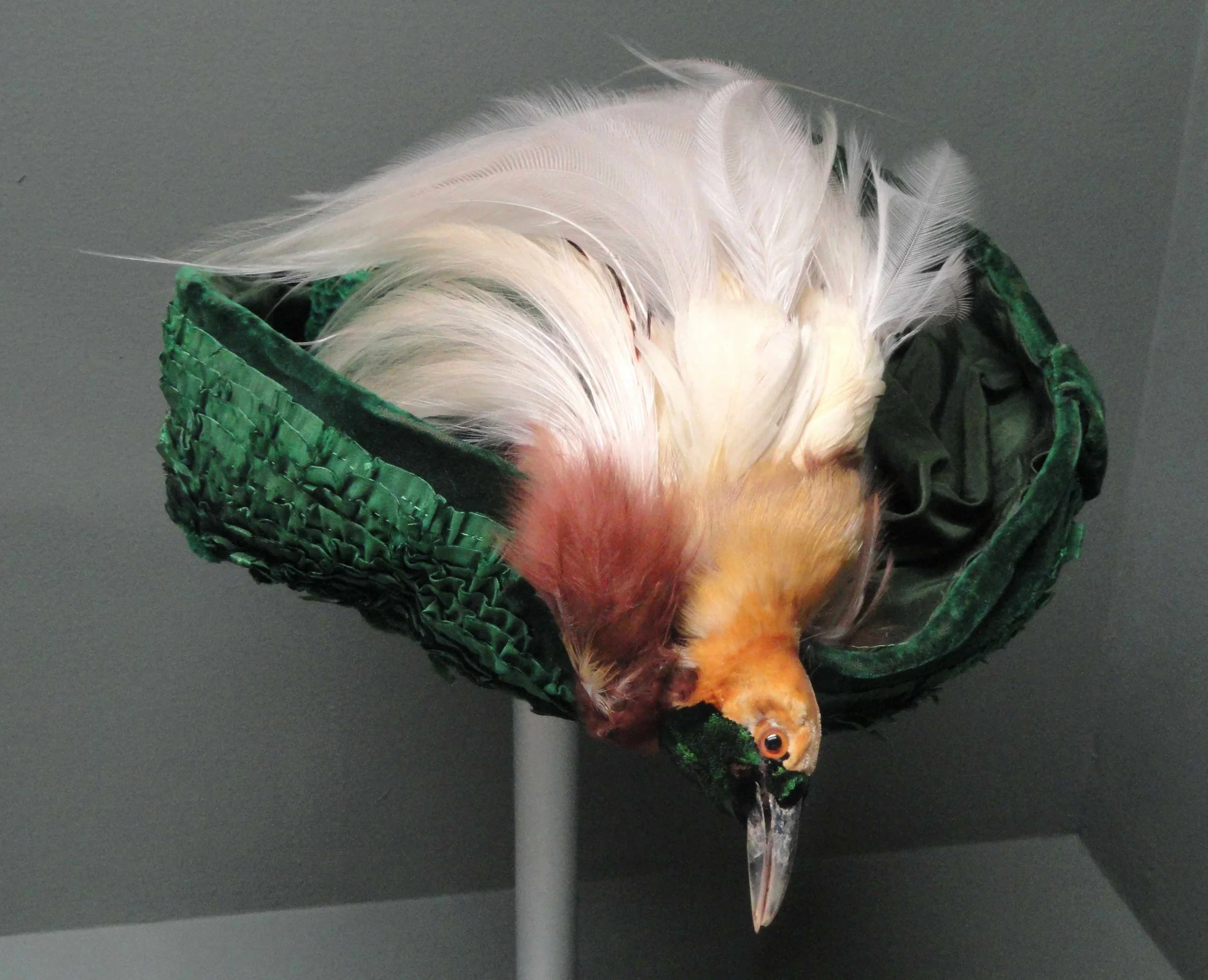
Credit: By Daderot - Own work, CC0, https://commons.wikimedia.org/w/index.php?curid=19911927
“This morning C. & Sis & Mrs. G. called for me & we went first to Patent Office & saw all that we wished there. They are painting & making improvements….Then we went to the Smithsonian & saw all that we cared about seeing. Sis admired nothing but the stuffed birds, some of these gay plumaged ones ‘would be so beautiful to wear on a bonnet.’”
We now know why bird populations, especially of colorful birds like these, plummeted in the nineteenth century. And that Julia wished her niece would not be so frivolous. By the way, when visiting the Patent Office, Wilbur was visiting her future employer, although she had no inkling then that she would become one of its first female employees in 1869.
January 31, 1864
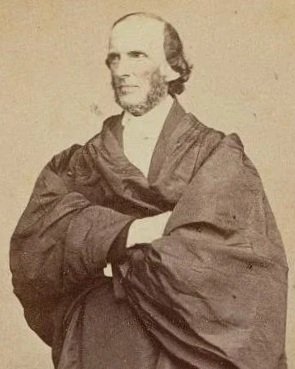
It was Unitarian minister Rev. William Henry Channing who first introduced Julia Wilbur to Alexandria. On January 31, 1864, she was in Washington hearing him preach.
What Julia Wrote on that day:
“Went to Unitarian Ch. & heard Mr. Channing from Micah 6-8. Fine discourse. He was himself entirely.”
The biblical passage says in part: “And what does the Lord require of you? To act justly and to love mercy and to walk humbly with your God.” Hmmm.
February 1, 1864
On Feb. 1, 1864, Julia Wilbur made a trip to the Capitol for a first-hand look at what was happening.
What Julia Wrote on that day:
“We wandered ‘up stairs & down stairs & in my lady’s chamber,’ & also in subterranean regions…There are refreshment rooms & ice cream rooms &c below. Then went into Supreme C. Room & sat awhile. Then to the Hall of Reps. & heard Mr. Channing open the Session with prayer, to which there was pretty good attention. Sat an hour, various bills were presented, but nothing interesting was said or done. & we journeyed over to the Senate Chamber. [Senators] Brown & Henderson of Missouri & Sumner spoke in reference to the death of Noell, member from Mo. Sumner was eloquent, every word told. Mr. Noell was the first man from a Slave State who proposed immediate Emancipation.”
A few bits of context. “Upstairs….” comes from the nursery rhyme Goosey Gander. The Supreme Court chambers were still in the Capitol. And Rep. John William Noell had died the previous year. Sen. Sumner admitted he only knew him “slightly” but “honored him much, as a public servant who at a critical moment discerned clearly the path of duty and had the courage to tread it.”
February 2, 1865
A new chapter for Julia Wilbur. On Feb. 2, 1865, she began her move to Washington from Alexandria, where she had worked since November 1862.
What Julia Wrote on that day:
“Sent a load of goods to Washington. This P.M. went to Capt. Lee, Q.M. for wagon. I am to have a 4 horse wagon to-morrow.
I have spent most of day in packing Boxes & Trunks….It does not seem as if I was about leaving Alex. I have just formed some pleasant acquaintances, & I do not wish to leave them. Then I have good meals at the Magnolia House, better than I have had in Alex. before, & better than I expect to get in W.—But all things considered I think it best to leave…..I think I shall part on friendly terms with all the household but [Superintendent of Contrabands Albert] Gladwin. But there are many unpleasant things attached to my present way of living which I hope to get rid of by going to W…..”
Honestly, she was a complicated woman and some of her interpersonal issues were of her own making. But she forged ahead.
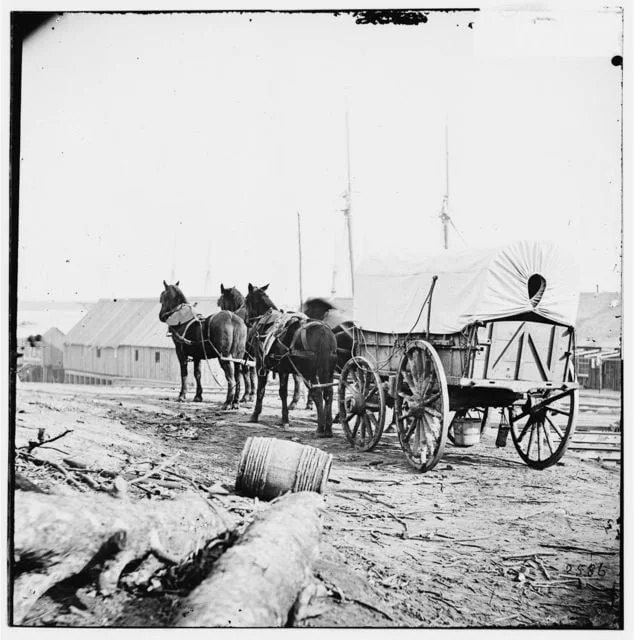
Army wagon, City Point, Virginia, similar to what Wilbur had use of as a moving van.
February 3, 1865
Julia Wilbur’s move from Alexandria into Washington (mentioned yesterday) took place on February 3, 1865.
What Julia Wrote on that day:
“Finished packing up, & at 9 A.M. an Army wagon came & into it were put the remainder of my goods & chattels. During over two years residence in Alex. things have somehow accumulated….At 10 A.M. I took leave of the household….I cleared my feet of the sacred soil, took a seat in the car, but [Superintendent of Contrabands Albert] Gladwin haunted us to the last minute, would shake hands & hoped I would have a good time in W., & I hoped he would have a good time wherever he was….When we reached 207 I St., the Army wagon was being unloaded. Thanks to Uncle Samuel for his assistance in my emigration from Virginia. We have not done much this P.M. Every thing is topsy turvey. & it will take some time to get settled. Things look cheerless & forbidding now, but it may be more pleasant here than I think it will be.”
She moved into a house sponsored by the Pennsylvania Freedman’s Relief Association. I’d like to say she was happy in her new surroundings, but…..no. (For one thing, those Army wagons that helped her move clattered by day and night.)
February 4, 1863
It’s been cold, we’ve been complaining—but what if we lived in 1863? On February 4, 1863, a deep freeze hit Alexandria.
What Julia Wrote on that day:
“Been to [Clothing Distribution] Room, & Barracks, & Slave Pen & Prison twice, took some clothes to some needy soldiers. It is a horrid place…..Bill to raise negro regiments has passed the House. Freezing weather. The poor creatures have crowded round our door to day, & we have given out considerable.”
Yes, she was both sympathetic and patronizing, reflective of her time.
February 5, 1866
The Freedman’s Bureau harped on the need for able-bodied, former slaves to work, rather than receive aid. Here’s what Julia Wilbur, working for the Bureau, witnessed on February 5, 1866, in Washington.
What Julia Wrote on that day:
“I went to corner 14th & M. A crowd of men were waiting to see Capt. Springin but could not get access to him.—They tell me they wait there day after day for somebody to come & hire them & there is (I think) about one chance for 50 applicants. Yet Capt. S. says he can get work for all.—Another officer says these people do not want to get places. They ask too much wages, &c. &c. Oh dear! I do not know about all this. But I do know that some of these people I am acquainted with & they worked faithfully as long as work was to be had.
I have to day seen men, women & children suffering from hunger & cold. I have not seen starving people before. Stout able bodied men ask me for bread & own they have to beg or starve…..There are many returned soldiers unpaid & they can get no work. Clothes are worn out. They know they are treated unjustly. They are getting desperate.”
Wilbur was sometimes patronizing, as I noted above. On Feb. 5, 1866, she was very clear-eyed.
Looking back
During the week of January 30 through February 5, across various years, Julia Wilbur moved to Washington, witnessed the poverty of many freedpeople (including veterans), and suffered her niece’s frivolity in the midst of all these conditions.
To follow along
I post day-by-days on Facebook (@ptwhitacre) and Instagram (@ptwhit). Please visit and comment there, or come back here for the overview.
I’ll also compile next week’s entries here and on Substack.