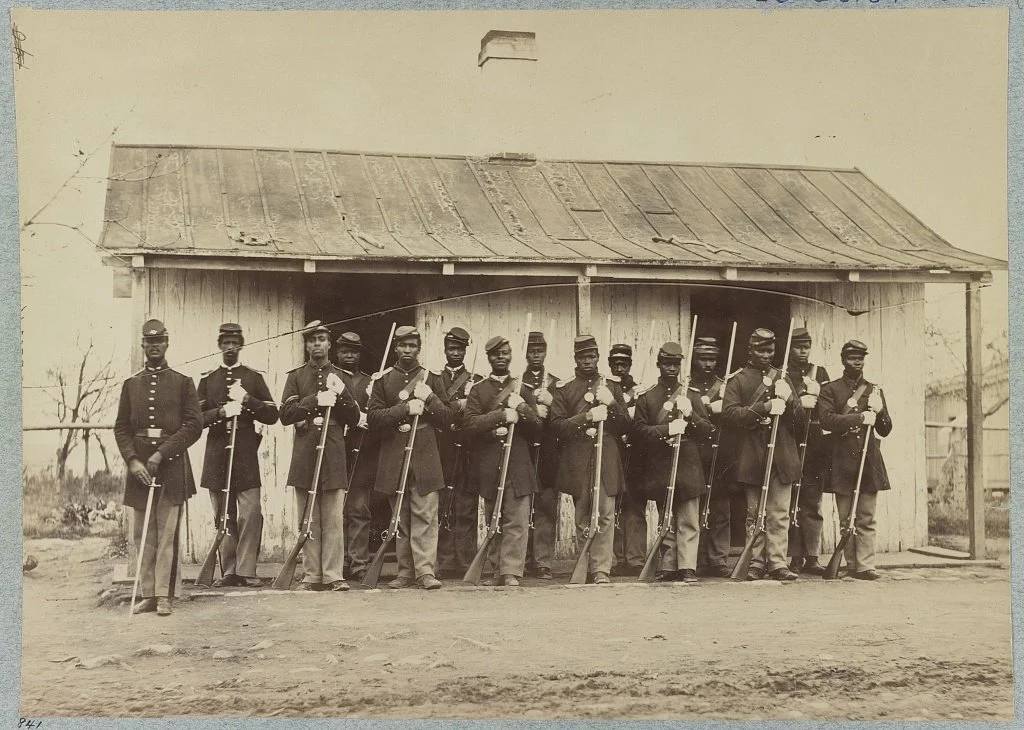
USCT at Fort Corcoran, in current-day Arlington. From the National Park Service.

In honor of Veterans’ Day, I return to a blog post that I wrote in 2019, with a few updates.
Original Post
Leslie Rowland, the director of the Freedom and Southern Society Project at the University of Maryland, spoke at our Civil War Roundtable last night [May 18, 2019]. Some of her information was familiar (e.g., approximately 180,000 African American men enlisted after the Emancipation Proclamation on January 1, 1863; disease caused more than death caused battlefield wounds; the power of their military service in aiming for broader freedoms).
The focus of the project, which began in the 1970s, is on documentation. Virtually all the material in the huge volumes, published as Freedom: A Documentary History of Emancipation, 1861-1867, comes from the National Archives. Official correspondence, letters, inventories, maps, and more are in different places in at the Archives—only a small percentage of which made it into books that approach (or, sometimes, exceed) 1,000 pages.
A few things I jotted down from Rowland’s talk last night (any errors are mine in transcription):
71% of eligible black men in the north enlisted (a higher percentage than among the white population);
It is often noted that 10% of the Union Army was African American. But that obscures the fact that they could not enlist until the later years of the war: in other words, the percentage during the time that they could actually serve was higher;
Among the approximately black 179,000 soldiers and 18,000 sailors: 33,000 men from free states; 42,000 from border states (Union, slave-holding states of Maryland, Delaware, Kentucky, and Missouri), and 99,000 from seceded states. Thus, most of the U.S. Colored Troops were recently enslaved men.
About 500,000 enslaved people escaped across Union lines. But 3 million people remained enslaved. Many lived (or were forcibly moved) deep within the “interior” of the South, where they had no direct with the war and, in many cases, no realization of the emancipation movement happening elsewhere.
The Archives contains some personal letters and reminisces, some within pension or other more official files. Letters from soldiers to their families reflect their motivations to serve, their plans to rescue enslaved family members, their plans for the future.
As Rowland noted, the records also bely a misconception that during the war, slavery more or less fell apart, even deep into the South. Slave-catchers still roamed with their packs of dogs. Black soldiers captured by the Confederates were usually killed (not treated as POWs). Many family members back home were viciously punished when the men escaped from the plantations to fight.
A Few Updates
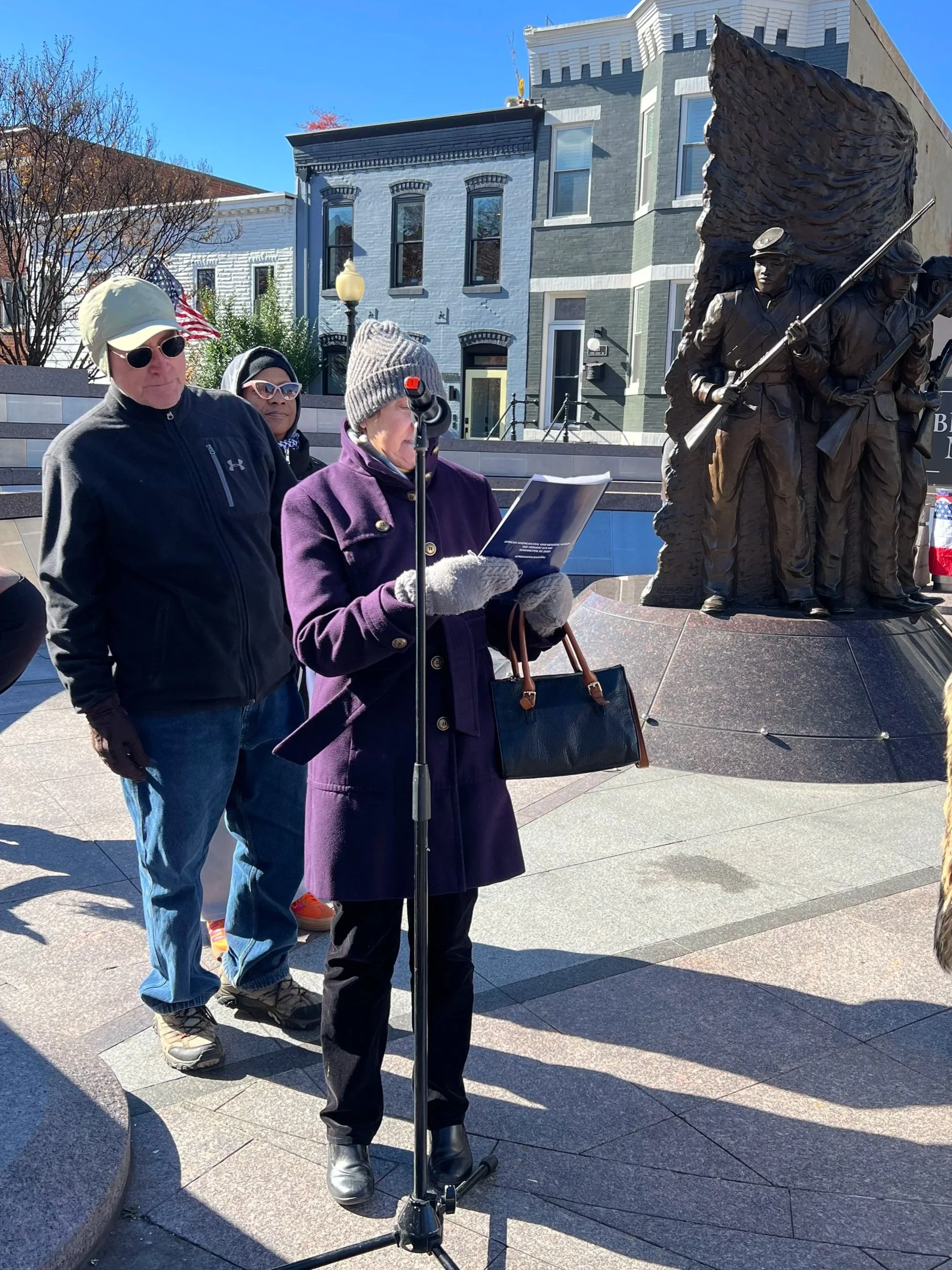
Reading out names at African American Civil War Museum, November 11, 2025
On Veterans Day 2025, I participated in an event at the African American Civil War Museum in downtown Washington to read the names of all USCT who served during the war. It was a cold, windy day, but a large group of readers got through them all. This year, the museum is getting ready to re-open to the public after a long struggle to get enough financial support for both exhibits and operations.
This past weekend, during a visit to Alexandria National Cemetery and other cemeteries in the Wilkes Street Cemetery Complex, I learned the story of Alfred Whiting from Dave Heiby, historian with Gravestone Stories. Whiting was a sergeant in Company I of the 54th Massachusetts. At the Battle of Fort Wagner in July 1863, he was taken prisoner. Unlike many USCT, he was not enslaved, although the alternative—almost two years of prison camps in North and South Carolina—was a grim alternative. He was part of a prisoner exchange in March 1865. Alas, still not a happy ending. Whiting had or soon contracted typhoid fever, and he died at L’Ouverture Hospital in Alexandria on June 25, 1865.
